
Glass Recycling in Facades – Challenges and Opportunities
Glass Recycling in Facades
Challenges and Opportunities
The importance of recycling at a time when the construction sector is urgently seeking more sustainable solutions.

By Maria Dimas*
Senior Facade Engineer, Eckersley O’Callaghan
Member of Society of Facade Engineering Greek Hub
The construction industry plays a critical role in global economic development, but it is also one of the largest contributors to the climate crisis. Internationally, the building and construction sector is responsible for approximately 37% of global carbon dioxide emissions and nearly 50% of global material extraction, placing significant pressure on natural resources and ecosystems (UNEP & GlobalABC, 2026). Therefore, reducing material waste and promoting circular economy principles have become essential for improving the environmental impact of the construction sector.
Inadequate material management and inefficient construction practices often result in significant amounts of waste being generated during the construction, renovation, and demolition of buildings. Following demolition, only 1% of the materials are reused in construction (CircoTrade, 2024). To address this challenge, the adoption of more systematic recycling and recovery strategies is essential. Glass, in particular, which can be recycled without compromising the quality of the final product, should be consciously incorporated into well-established recycling systems as part of a broader transition toward a circular construction industry.

Existing buildings scheduled for renovation are among the most suitable for the recovery and recycling of construction materials. When planning for recycling, the logistics differ significantly from the demolition and disposal process. In the case of glass, minimizing contamination is essential to ensure that the material meets the quality requirements for recycling. Consequently, early engagement with glass manufacturers is advisable when recycling existing glazing is being considered.
Manufacturers can assist with the removal, cleaning, and collection of glass, facilitating its reintegration into their production processes.
Manufacturers can also verify which types of glass within a building are suitable for recycling. For example, interior partition glass is generally among the easiest to recycle because it is less exposed to environmental contaminants. Facade vision glazing can also be recycled, provided it is carefully removed and stored. In contrast, fire-resistant glazing and fritted glass are among the glass types that are typically not considered suitable for recycling.
There are two main methods for retrieving glass for recycling on site: removing and transporting the glass as a whole pane or as cullet. In the former approach, specialized equipment is used to remove the glazing units from their frames. The panes are then stored vertically until they can be transported from the site. This method requires more storage on site to protect the glass from accidental breakage and contamination.
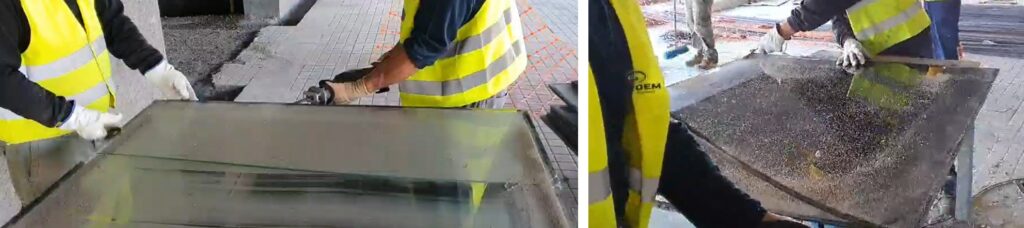
Alternatively, if the second method is preferred, the glass panes are removed from the facade, placed horizontally onto a temporary table on site, and broken directly over collection bags. The glass panel perimeter with the spacer, which often include more contaminants, are discarded. This process requires less storage space on site and is typically faster, however focuses on the recycling of glass, rather than the potential reuse of intact glass panes.
METHOD 1

METHOD 2

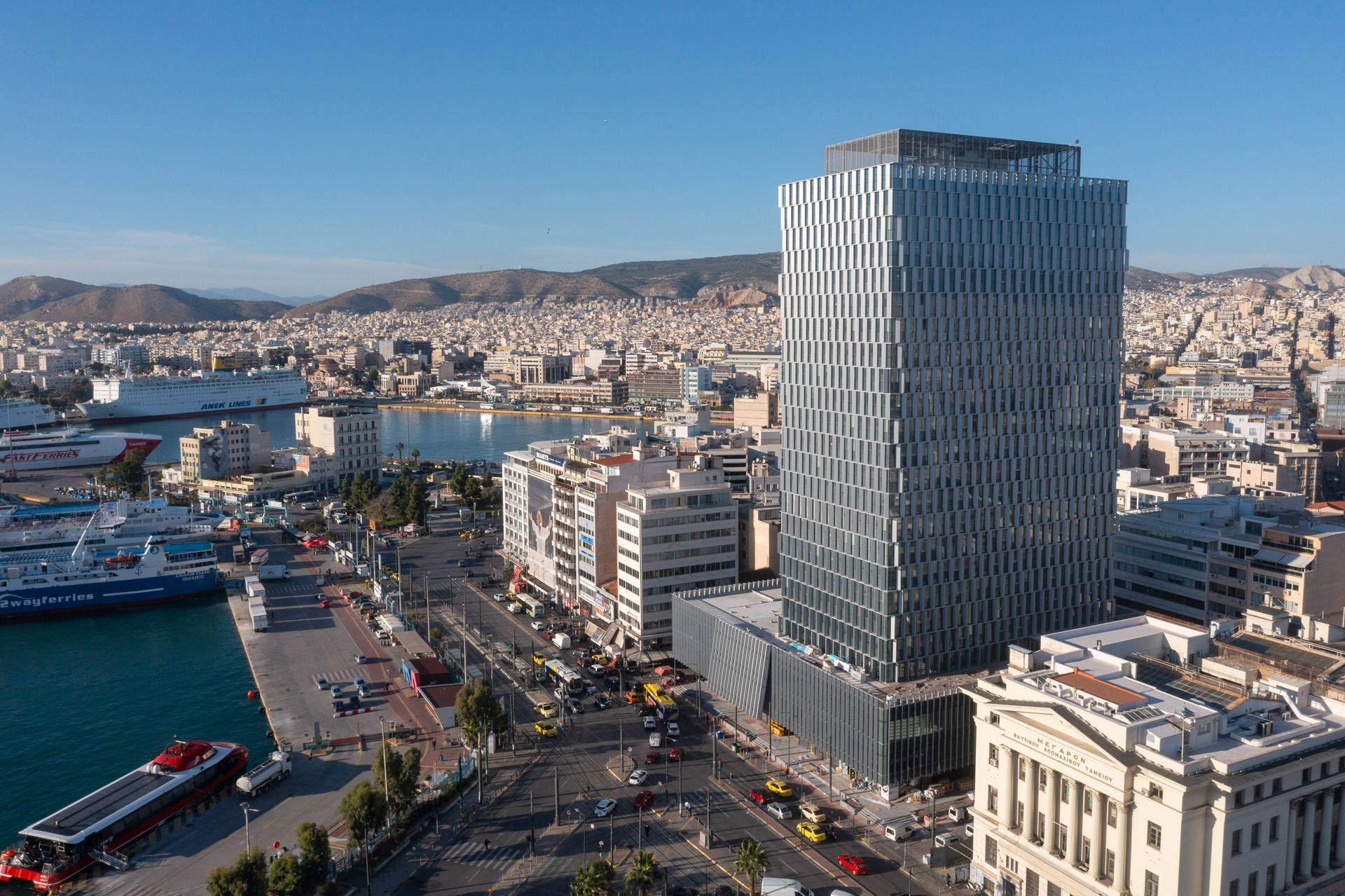
Although glass recycling from existing facades is currently more widespread in Northern Europe and the UK, the recent refurbishment of the Piraeus Tower represents a noteworthy example within the Greek context. From the outset, the project prioritized the reduction of its environmental impact and therefore incorporated the recycling of selected materials as an integral part of the design process. For the existing glazing, discussions with glass manufacturers began at an early stage of the project. Ultimately, in collaboration with Saint-Gobain, 125 tonnes of end-of-life glass were removed from the building and recycled at the company’s float plant in Calarași, Romania (Saint-Gobain, 2023). The glazing units were crushed directly on-site and transported in collection bags, as illustrated in the accompanying photographs.
Considering organized glass recycling from existing buildings is still a relatively new practice and requires additional coordination among project stakeholders, it is not yet recommended for smaller-scale projects where the quantities of recoverable glass are limited. Planning for glass recycling should begin as early as possible, ideally during the design phase and in close collaboration with glass manufacturers. Despite the current implementation challenges, the recycling of glass from existing buildings represents a promising circular economy strategy, contributing to waste reduction, the conservation of raw materials, and the mitigation of the construction industry’s environmental impact.
Bibliography
United Nations Environment Programme (UNEP), & Global Alliance for Buildings and Construction (GlobalABC). (2026). Global status report for buildings and construction 2025–2026: Building fast. Falling short. United Nations Environment Programme. https://globalabc.org/resources/publications/global-status-report-buildings-and-construction-2025-2026
CircoTrade. (2024, August 29). Retrieved from ‘Futures trading: A way to scale-up the re-use of building materials’.
Saint-Gobain (2023, December). Retrieved from ‘The Essential Europe’
* Η Μαρία Δήμα σπούδασε Αρχιτέκτονας Μηχανικός στο Εθνικό Μετσόβιο Πολυτεχνείο και αποφοίτησε το 2018. Συνέχισε τις σπουδές της στο TU Delft, στην Ολλανδία, όπου ολοκλήρωσε το μεταπτυχιακό της στο Building Technology το 2020.
Μετά την ολοκλήρωρη των σπουδών της, ξεκίνησε να εργάζεται ως Facade Engineer στην εταιρεία Eckersley O’Callaghan με έδρα το Λονδίνο, όπου εργάζεται μέχρι και σήμερα. Έχει συμμετάσχει σε έργα στο Ηνωμένο Βασίλειο και στην Ευρώπη, αναλαμβάνοντας την τεχνική υποστήριξη, τον σχεδιασμό και την αξιολόγηση της απόδοσης των προσόψεων. Μεταξύ των σημαντικότερων έργων που έχει συνεισφέρει συγκαταλέγονται ο Πύργος του Πειραιά στην Ελλάδα, το Wembley North East Lands development και το 75 London Wall στο Λονδίνο.
Παράλληλα αποτελεί μέλος της ομάδας Βιώσιμης Οικονομίας στην εταιρεία, όπου συμμετέχει στην έρευνα και προώθηση αειφόρων πρακτικών στον κατασκευαστικό τομέα.

